
If you're concerned about why your rose leaves are turning yellow, you need to identify the issue quickly to save your beautiful blooms.
Roses are resilient plants, capable of withstanding some neglect and aggressive pruning. But various problems can affect your rose garden ideas if left unaddressed.
According to gardening expert Tony Hall, "prevention is better than cure" when it comes to nurturing plants. Ensuring proper planting, watering, and feeding is crucial for your rose's thriving. This foundation helps your roses resist pests and diseases, promoting a healthy summer growth.
Learn how to plant roses correctly and maintain their health by understanding proper pruning techniques.

Understanding Yellowing Rose Leaves
Yellowing leaves on roses can result from various factors, so it's essential to explore possible causes.
"Leaves are like the plant's skin; when issues arise, we must examine the soil," suggests Eric Lo, CEO of a plant care system. Soil that is overly wet may lead to root rot, while dry soil can cause dehydration. Nutritional or pH imbalances might also be at play.
Diseases can lead to yellowing leaves too, so learn to identify common issues that affect roses and how to treat them.
1. Improper Watering
According to master gardener Gabriel J. Croteau, a frequent cause of yellow leaves is insufficient water. This often occurs when roses are overfed and under-watered.
Additionally, overwatering can also cause yellowing. Roses require regular watering, but continual wet conditions can lead to root rot or fungal infections, causing leaves to yellow and drop.
Typically, established roses need watering once a week during spring and summer, increasing frequency during heat waves. Newly planted roses should be watered every other day, aiming for about an inch of water. Adjust your watering routine based on rainfall and soil drainage.
2. Inadequate Sunlight
Roses thrive in at least six hours of sunlight daily. If your rose leaves are yellow despite proper watering, insufficient light could be the cause.
Some rose varieties tolerate partial shade, so check the specific needs of your plants. If light deprivation seems to be an issue, consider relocating the shrub to a sunnier location.
When moving roses, sprinkle mycorrhizal fungi in the new hole to boost root contact and help with reestablishment.

3. Heat Stress
Roses can suffer from excessive heat, leading to dry, yellowing leaves. During heatwaves, increase watering frequency, ensuring it reaches the soil without wetting the leaves in direct sunlight to avoid scalding.
4. Nutrient Deficiencies
Yellow leaves, or chlorosis, may indicate a lack of essential nutrients. Tony Hall mentions that iron deficiency in young leaves or a lack of magnesium or manganese in older leaves can cause interveinal yellowing.
Check your soil health with a testing kit to identify deficiencies and make necessary adjustments.
5. pH Imbalance
An incorrect pH level in the soil can lead to yellow leaves, easily diagnosable with a soil testing kit. Gabriel advises that roses thrive in a pH range of 6 to 7, and any deviation requires corrective measures before planting or adding amendments like lime or sulfur.
6. Yellow Leaves with Black Spots
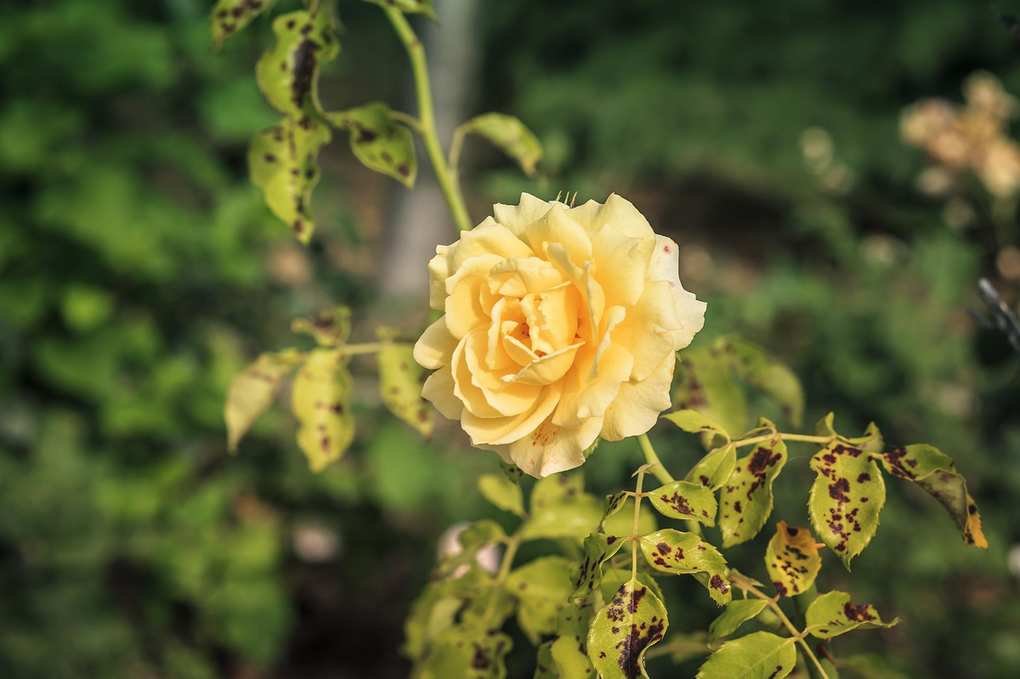
If your yellow leaves also feature black spots, black spot disease is likely responsible. Though many modern roses are bred to resist diseases, black spot remains common.
This fungal infection hampers photosynthesis, leading to yellowing and leaf drop. Applying a thick layer of well-rotted manure can help suppress this disease while also retaining moisture and limiting weeds. Chemical sprays are also available for treatment; apply them at the first signs of infection.
7. Pest Infestations
If your rose leaves are turning yellow, inspect for pests. Look for holes in leaves, which may indicate an infestation of aphids or scale insects. These pests hide in plant crevices and on the undersides of leaves.
To eliminate them, spray your plants with a strong stream of water, followed by a soap and water wash, or use insecticidal soap or homemade sprays.
Spider mites are another concern; they feed on sap and can severely damage roses. Inspect leaves for tiny dots, typically found on their undersides. To combat them, prepare a solution of one part water and two parts rubbing alcohol, adding a couple of drops of dish soap. Apply this directly to affected areas, rinsing thoroughly afterward.
Should You Remove Yellow Leaves?
Removing yellow leaves can help prevent disease spread but may hinder photosynthesis. For outdoor roses, it's generally advisable to remove these leaves to protect against pests. Conversely, for indoor roses, retaining yellow leaves can be beneficial as they absorb excess moisture, preventing root rot.


