[This story is a personal narrative reflecting on experiences while traveling. It began as a project during graduate school and has evolved into a cherished tale.]
On a spring break journey in 2005, I spotted a camel while driving south on I-55, aiming for Memphis. Bored, I scanned billboards until one caught my eye—a camel in a pen beside the road. I had to investigate, so I took the next exit to check it out.
This camel resided at a concrete statue business, surrounded by fields. At the entrance, a black welcome sign featured camel silhouettes. The property had a solitary metal building filled with various concrete creations. An elderly man in a baseball cap was busy loading a large giraffe statue onto a trailer, and I approached him to ask if I could meet the camel.
He excitedly pulled out his wallet, revealing photos of a baby camel, as if showing off a grandchild. He shared the story of how he got her in May 2003, when she was just 10 days old and all legs. He pointed to a photo of her kissing him, saying she was quite wild.
He named her Miss C, “Miss for female and C for camel,” he chuckled. His name was Clarence Lee Shirrell, and he was 79.
 A glimpse of Miss C through the shop window. His friend had suggested that a camel would attract more customers than any billboard.
During my travels back home to South Carolina, I began taking a two-hour detour just to see Miss C and Mr. Shirrell. I spent hours discussing life and snapping photographs for my photojournalism project. Despite our 55-year age difference, we developed a strong friendship.
When I decided to title my project “The Old Man and the Camel,” I feared he might be offended, but he just laughed, saying it was a perfect title. His laughter reassured me, and I often referred to him as such to my family and friends.
Each visit brought new animals—Jack and Jill, the emus; Bob, the reclusive peacock; and Snowball, the fluffy guard dog who kept coyotes at bay.
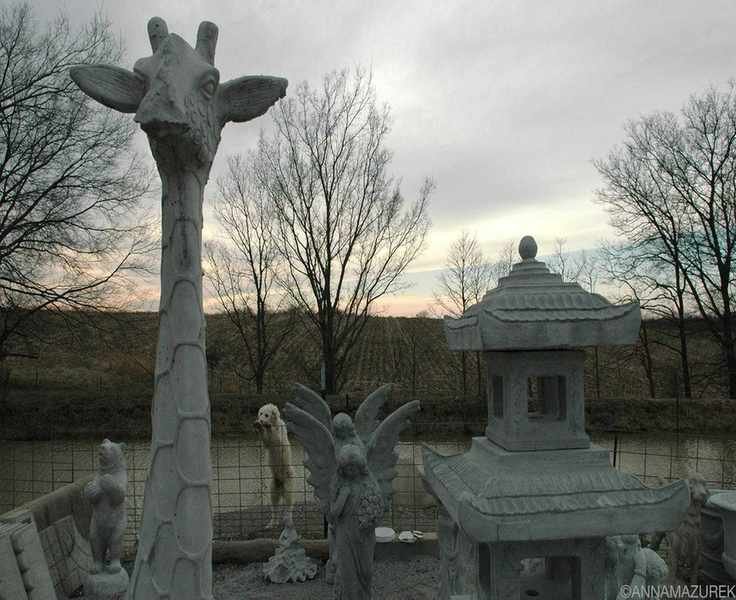 Snowball, the protective dog, looked after the other animals.
During a January stop, I entered the workshop and met a baby zebra for the first time. “Have you ever seen a more beautiful striped mule?” he joked about Ulysses, a Grant’s zebra. He rescued Ulysses from Louisiana, bringing him home in the front seat because it was too cold for him in the trailer.
Ulysses spent his first winter indoors but would soon have a large pen next to Miss C's, serving as an advertisement for the business. Curious travelers like me often stopped to take a look.
One afternoon, while photographing the animals outside, I returned to say goodbye just as Mr. Shirrell was smoothing the edges of a concrete angel.
 Ulysses nibbled on concrete while Mr. Shirrell prepared some hay. The baby zebra stayed indoors until spring.
The workshop featured large windows overlooking the interstate. A picture of the zebra in his truck sat on his desk, surrounded by stacks of animal photos for visitors to browse. An empty black chair faced his workbench, as if reserved for company.
“Take a seat for a moment,” he invited. I settled into the chair amidst the hustle of the woodstove and the zebra munching hay.
His baseball hat shaded his kind blue eyes, similar to one my grandfather wore. I mentioned feeling old at 24.
“I don’t mind aging,” he replied. “It means I didn’t die young.” His perspective was insightful, though it’s hard for someone in their 20s to embrace aging.
 Clarence Lee Shirrell works on a statue in his workshop in Missouri.
Often, I’d join him in his truck to visit a small buffet in Fruitland, known for its baked bread in flowerpots and excellent sweet tea.
We chatted about our families. He had lived in southeast Missouri his whole life, except for a two-year army stint. After his first wife passed away from breast cancer, he started his own concrete business in 1981. He remarried on Valentine’s Day eight years later to Donna, who was nearly 20 years younger. I was fortunate to join him for lunch with his high school friend, Lon Maxey, who initially convinced him to get the camel.
“I’ve been fortunate to do what I love,” he often said.
He enjoyed hearing about my father, who also took pride in his craftsmanship as a furniture maker. Like my dad, he encouraged my aspirations of becoming a traveling photographer.
After nearly two years, graduation marked the end of my visits. My parents came to Missouri for the ceremony, and I insisted we take the detour to meet Mr. Shirrell. However, we missed him by an hour due to a delayed departure. I took photos with my family and sent them to him later.
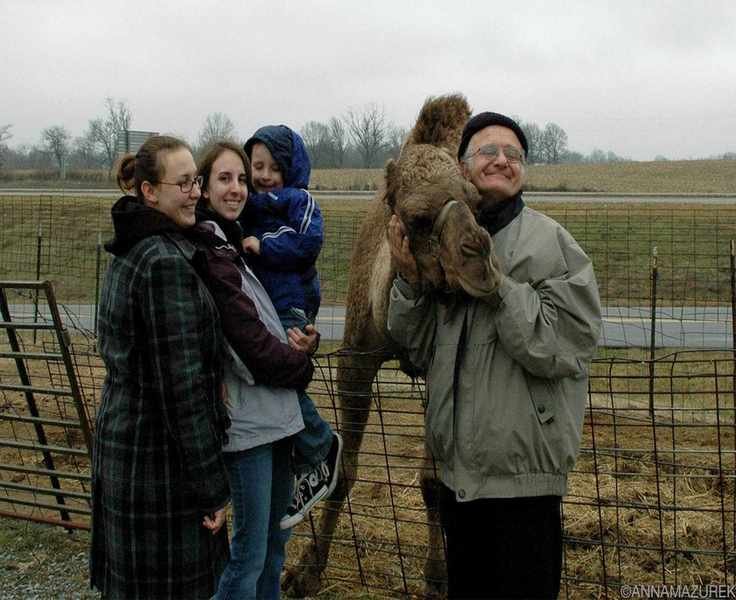 My family and I posed with the camel after the graduation ceremony.
Relocating to Alabama for an internship launched my freelance career. We kept in touch through cards and letters. I shared my travels and published stories, and he updated me about new animals and statues. I felt heartbroken when I learned Ulysses had died. Receiving his handwritten letters always brought a smile.
In 2008, I took a leap and spent 13 months traveling through Australia and Southeast Asia, sending him postcards from each destination.
Shortly after returning home, I received a card from him, encouraging me to stop by on my travels.
One memorable visit after Christmas in 2006 was supposed to be brief but stretched to two and a half hours.
As it grew dark, I reluctantly prepared to leave for my three-hour drive back to school.
“You made my day by stopping by,” he said, and I felt the same joy. His presence always lifted my spirits.
 On my last visit in 2013, he introduced me to Stripes, the zebra.
When I moved to Southern California in 2013, I rerouted my trip to Missouri specifically to see him again. He had a new mustache and was dressed in a light blue fedora and brown jacket. I recorded a few interview clips with him for a video project that never materialized. He had sold the business to Christa, who employed him part-time.
He introduced me to Stripes, taking him for a stroll around the property, stopping by the camel’s pen where Miss C affectionately nuzzled him.
Leaving still left me smiling as I drove away.
California didn’t suit me, so I moved to Texas the following spring, where my career began to flourish. It took time, but I achieved my goal of being published in prominent magazines.
As we continued exchanging letters, his handwriting became less legible. Eventually, Donna began writing the cards for him. I instructed them to send everything to my parents to avoid losing anything during my many moves. My mom would update me whenever a card arrived.
In May 2024, I received a card I had dreaded. While in Malta, I learned that Mr. Shirrell had passed away at 97. Donna shared that he cherished our friendship, and I wept as I wrote this because I felt the same way.
When I visited my parents a month later, I discovered a shoebox labeled “old man and camel.” Inside, I spread out all the cards and letters he had sent me over our 19 years of friendship.
 Every card, photo, and letter from Clarence Lee Shirrell is a memory I cherish.
These included photos of animals, a large alligator statue, and a homemade Christmas card featuring Miss C. There were postcards from Greece and China, detailing his travels with Donna. His letters shared tales of new animals, including ze-donks, chickens, ducks, and goats.
I gathered digital photos of him to share with his family and printed some for Donna. I asked if I could keep sending letters and postcards, believing that he would have liked that.
As I put the letters back in the shoebox, nostalgia washed over me, reminding me of our visits and my road trips. He taught me that aging can be embraced and that friends may come from the most unexpected places. Most importantly, I was grateful I took the time to pet the camel.