
Approximate Breast Weight by Cup Size
Curious about your breast weight? You're not alone! The weight varies based on bra size, body type, and breast tissue density. Here, you'll find estimates based on common measurements.
Note: All weights below reflect the total for both breasts combined, assuming an average band size of 34. Individual results will vary.
|
Cup Size |
Weight (Pair) in Pounds |
Weight (Pair) in Kilograms |
|---|---|---|
|
AA |
0.5 – 0.7 lb |
0.23 – 0.32 kg |
|
A |
0.9 – 1.1 lb |
0.41 – 0.50 kg |
|
B |
1.0 – 1.5 lb |
0.45 – 0.68 kg |
|
C |
1.8 – 2.5 lb |
0.82 – 1.13 kg |
|
D |
2.5 – 3.5 lb |
1.13 – 1.59 kg |
|
DD/E |
3.0 – 4.5 lb |
1.36 – 2.04 kg |
|
F |
4.0 – 6.0 lb |
1.81 – 2.72 kg |
|
G |
5.0 – 7.0 lb |
2.27 – 3.18 kg |
|
H |
6.0 – 8.0 lb |
2.72 – 3.63 kg |
-
Band size is key: A 30D and a 38D will have different cup volumes. Larger bands yield more breast volume and consequently more weight.
Keep in mind: fit and comfort matter more than the numbers. These estimates can enhance your understanding of your body but shouldn't dictate your experience.
Understanding Bra Sizes: Band, Cup, Volume, and Weight
When you come across sizes like “34D” or “36G,” it indicates two measurements: band size and cup size. Both factors affect breast weight.
Explore what each term means; for example, check out full coverage bras and their benefits.
-
Band size (30, 32, 34, etc.): This measures your rib cage right under your bust. Most brands round to the nearest even number.
-
Cup size (A, B, C, D, etc.): Determined by the difference between your bust measurement (at the fullest point) and your band size. In the US, each inch of difference equals one cup letter.
-
Cup letters vary: A 30D has less breast volume than a 38D, even though both have a “D” label. The letter only indicates the difference between bust and band, not total tissue.
This illustrates that breast volume, the actual amount of tissue, dictates weight—not the letter alone. For those with larger busts, finding comfortable bras that deliver support and style is crucial.
Next are “sister sizes.” Sizes like 30D, 32C, and 34B share similar cup volumes; as the band increases, the cup letter decreases to balance. If you wear one of these sizes, your breasts generally weigh the same as someone in another size within the same family. Similarly, 34A, 32B, 30C, 28D are sister sizes with equivalent cup volume.
Breast Volume and Weight: Understanding Cup Letters
Breast volume reflects the three-dimensional amount of breast tissue—not just how prominent they are. Two people may both wear a 34C or G cup but have different breast volumes.
Variations in size and shape can be significant. Round, teardrop, wide-set, and shallow breasts all fit differently into the same cup. Studies from 2000 to 2020 show substantial differences in volume and weight among people with the same nominal cup size.
Density also matters. Fatty and glandular tissue have different weights per volume. Denser glandular tissue (common in younger women) may weigh more than the same volume of fatty tissue. Thus, two individuals with the same breast volume could have different weights, a key consideration when selecting a sports bra for large breasts.
In short, the cup letter is just an approximation. Actual breast volume and tissue composition determine weight.
Cup Size Weight Chart by Band Size
The following chart outlines weight estimates based on band and cup size combinations. These figures assume average breast density; actual weight may differ based on body composition. If you need help finding comfortable no-wire bras, this guide can assist in choosing options that ensure support.
|
Cup Size |
Band 32 (Pair) |
Band 34 (Pair) |
Band 36 (Pair) |
Band 38 (Pair) |
|---|---|---|---|---|
|
A |
0.8 – 1.0 lb / 0.36 – 0.45 kg |
0.9 – 1.1 lb / 0.41 – 0.50 kg |
1.0 – 1.3 lb / 0.45 – 0.59 kg |
1.2 – 1.5 lb / 0.54 – 0.68 kg |
|
B |
1.0 – 1.3 lb / 0.45 – 0.59 kg |
1.2 – 1.5 lb / 0.54 – 0.68 kg |
1.4 – 1.8 lb / 0.63 – 0.82 kg |
1.6 – 2.0 lb / 0.73 – 0.91 kg |
|
C |
1.4 – 1.8 lb / 0.63 – 0.82 kg |
1.8 – 2.3 lb / 0.82 – 1.04 kg |
2.0 – 2.6 lb / 0.91 – 1.18 kg |
2.2 – 2.8 lb / 1.00 – 1.27 kg |
|
D |
1.8 – 2.4 lb / 0.82 – 1.09 kg |
2.4 – 3.0 lb / 1.09 – 1.36 kg |
2.6 – 3.4 lb / 1.18 – 1.54 kg |
3.0 – 3.8 lb / 1.36 – 1.72 kg |
|
DD/E |
2.4 – 3.0 lb / 1.09 – 1.36 kg |
3.0 – 4.0 lb / 1.36 – 1.81 kg |
3.5 – 4.5 lb / 1.59 – 2.04 kg |
4.0 – 5.0 lb / 1.81 – 2.27 kg |
|
F |
3.0 – 4.0 lb / 1.36 – 1.81 kg |
4.0 – 5.0 lb / 1.81 – 2.27 kg |
4.5 – 5.5 lb / 2.04 – 2.49 kg |
5.0 – 6.5 lb / 2.27 – 2.95 kg |
|
G |
4.0 – 5.0 lb / 1.81 – 2.27 kg |
5.0 – 6.0 lb / 2.27 – 2.72 kg |
5.5 – 7.0 lb / 2.49 – 3.18 kg |
6.0 – 7.5 lb / 2.72 – 3.40 kg |
Chart notes:
-
Values represent rounded ranges, not precise measurements.
-
This assumes average body fat percentage and typical breast density for adults aged approximately 20–50.
-
D, DD/E, and F cups (noted) are where weight often begins to impact posture noticeably for many women.
For sister sizes, note that 34B, 32C, 30D, and 28E have similar volumes, as do 36B, 34C, 32D, and 30E, 38B, 36C, 34D, and 32E. This means the weight of one cup remains consistent across these groupings.
Examples of additional sister sizes with similar weights include:
-
34C, 32D, 30E, 28F
-
36C, 34D, 32E, 30F
-
38C, 36D, 34E, 32F
-
40B, 38C, 36D, 34E
-
40C, 38D, 36E, 34F
-
42B, 40C, 38D, 36E
-
34D, 32E, 30F, 28G
-
36D, 34E, 32F, 30G
-
38D, 36E, 34F, 32G
-
40D, 38E, 36F, 34G
-
42C, 40D, 38E, 36F
-
34E, 32F, 30G, 28H
-
36E, 34F, 32G, 30H
-
38E, 36F, 34G, 32H
-
44B, 42C, 40D, 38E
-
44B, 42C, 40D
These equivalencies explain why many women wear the wrong size—they might have been fitted for a sister size without understanding that the cup volume remains unchanged.
Impact of Breast Weight on Posture and Discomfort
Breasts weighing a D cup or more in common ranges like 34–38 increase strain on the upper body. Research reveals that women with D+ cups experience a 20–30% higher prevalence of neck pain than those with smaller sizes.
Here’s how excess weight affects your body:
-
Forward pull: Heavier breasts can pull on the upper spine, leading to hunched shoulders and a forward head posture, which may become habitual.
-
Shoulder strap indentations: Excess weight in shoulder straps can create indentations in the soft tissue, causing discomfort. Narrow straps exacerbate the issue.
-
Chronic tension: The neck, upper back, and shoulder blade muscles work harder to balance the weight, often leading to headaches, stiffness, and mid-back pain.
-
Exercise discomfort: Activities like running and jumping can be painful without adequate support, as larger breasts can experience 2–4 times more impact force per pound.
Even moderate cup sizes can lead to shoulder pain if the wrong size or lack of support is present. The right fit is crucial.
If you consistently experience back pain, deep shoulder grooves, or limitations in activity, consult a doctor or physiotherapist. You shouldn’t have to accept discomfort.
Estimating Your Own Breast Weight
At-home methods for estimating breast weight yield only rough estimates. Weighing directly can be awkward and inaccurate due to weight distribution when leaning over.
Here’s a straightforward approach:
-
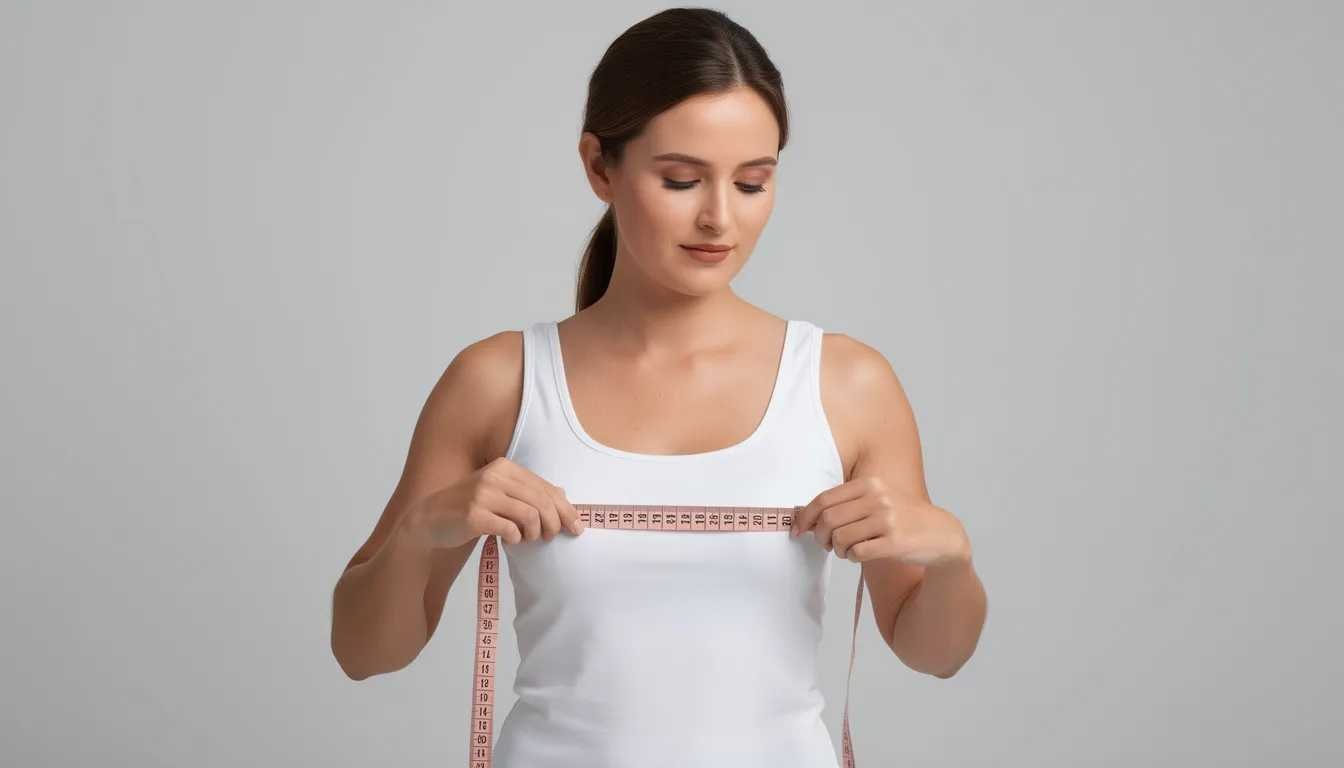
Measure your band size: Use a measuring tape snugly around your rib cage, under your bust. Round to the nearest even number.
-
Measure your bust: Wrap the tape loosely around the fullest part without compressing.
-
Determine your cup size: Subtract your band size from your bust measurement. Each inch corresponds to one cup letter in the US system (1” = A, 2” = B, etc.).
-
Check your estimated weight: Refer to the chart above for your band and cup combination.
-
Adjust for body composition: If you carry more fat, your breasts may weigh slightly more. Pregnancy, hormonal changes, and aging also influence weight.
For a more precise estimate, consider breast volume by treating each breast as a hemi-ellipsoid shape. Measure the base width, projection, and height, then multiply these measurements (in cm), and multiply the result by 0.52 to obtain approximate volume in cubic centimeters, which translates roughly to grams.
These methods are mainly for curiosity and are not suitable for precise medical calculations. Consult a plastic surgeon for formal volumetric assessments regarding augmentation or reduction.
Variations in Cup Size and Weight by Region
A “D cup” in the US differs from a “D cup” in the UK, EU, or Australia due to varying sizing systems. The same cup letter can denote different volumes and weights.
Here's how major systems compare:
|
Region |
Band Size Method |
Cup Size Increments |
|---|---|---|
|
US/UK |
Inches (30, 32, 34...) |
1 inch per cup letter (A, B, C...) |
|
EU |
Centimeters (65, 70, 75...) |
2 cm per cup letter |
|
France/Spain/Belgium |
Centimeters + 15 (80, 85, 90...) |
2 cm per cup letter |
In the UK system, DD follows D, while some European brands go straight to E. Australia utilizes a different method that often caps at E before changing notation.
Since the 1990s, “vanity sizing” has influenced consistency. Certain fashion brands have altered their sizing to enhance customer perceptions of their tags, further complicating cup size meanings.
Practical tip: When comparing cup size weight charts from various countries or shopping internationally, always consult conversion tables and rely on your accurate measurements, not just the cup letter.
Selecting the Right Bra for Breast Weight
The right bra redistributes breast weight, relieving strain on your shoulders and upper body. Studies indicate that well-structured supportive bras can decrease shoulder strap load by 70–80%, shifting support to the band.
When shopping, especially with larger breasts or discomfort, look for:
-
A snug, supportive band: It should sit level around your rib cage and provide most support. You should fit two fingers under it, no more. If it rides up in the back, it’s too loose.
-
Fully enclosing cups: No spillage, no gaping, and no “quad-boob” effect, indicating you've found the right cup size.
-
Wide, padded straps: Narrow straps press into shoulders, while wider straps distribute weight more evenly, lessening grooving.
-
A flat center gore: This part between the cups should lie flat against your sternum. If it lifts away, the cup size is likely too small.
For exercise, a high-impact sports bra is crucial for larger breasts to minimize motion and prevent strain. For daily wear, prioritize structure and support over style, especially for those in the upper range of the cup size weight chart (F, G, H cups).
Well-structured wire-free options are great during pregnancy, post-surgery, or for anyone seeking comfort without underwires. Firm construction is key, not necessarily rigid wires.
Many women unknowingly wear the wrong size—some estimates indicate up to 80% do. Professional fittings are advisable following major life changes like pregnancy, significant weight changes, or menopause, as breast volume and weight often shift during these periods.

Common Questions Regarding Cup Size and Breast Weight
What does an average C cup weigh? For a 34C, expect around 1.8–2.5 lb (approximately 0.82–1.13 kg) for both breasts combined, or about 0.43 kg (0.95 lb) per breast. A 36C will weigh slightly more, around 2.0–2.6 lb total.
Are DD breasts significantly heavier than D? DD/E cups generally add about 0.5–1.0 lb (0.25–0.5 kg) per pair compared to D cups of the same band size. This difference is perceptible but not extreme; a 34DD might weigh 0.56 kg (1.2 lb) more than a 34D.
Do larger cup sizes always result in back pain? Not necessarily. Many with large cup sizes experience no pain when wearing a suitable bra and maintaining good posture. Others may struggle with even moderate sizes if they wear the wrong fit or have poor posture. Factors like muscle strength, activity level, and bra quality contribute.
Can exercise alter my cup size or breast weight? Weight loss often diminishes fat throughout the body, including breasts, potentially lowering both cup size and weight. However, targeted chest exercises mainly strengthen the pectoral muscles beneath breast tissue without significantly altering size. Pregnancy and breastfeeding may temporarily increase breast weight (often by 1 lb or more per breast due to milk production).
How do US and UK bra sizes differ? Both use inches for band size and letter increments for cup size, but diverge after D. The UK system employs DD, E, F, FF, G, GG, H, while the US generally uses DD, DDD (or E), F, G. A UK F cup may correspond to a US DDD or G depending on the brand.
Why might my breasts feel heavier than the chart indicates? Perceived weight can be influenced by tissue density (denser glandular tissue weighs more), hormonal fluctuations during your menstrual cycle, pregnancy, and overall body composition. If you have particularly heavy breasts relative to your frame, the strain on your upper body may seem disproportionate to your actual cup weight.
When should I consult a doctor regarding breast weight? Seek medical advice if you experience:
-
Chronic back, neck, or shoulder pain that doesn’t improve with proper bra support
-
Deep, lasting shoulder grooves from straps
-
Frequent rashes or skin irritation beneath the breasts
-
Activity limitations affecting your quality of life
-
Any sudden changes in breast size or weight with no clear cause
Do cup sizes hold the same meaning across different countries? No. The same cup letter can represent different volumes based on whether the bra uses the US system, UK system, European sizing, or another standard. Research has highlighted these inconsistencies. Always measure yourself and refer to conversion charts when purchasing bras from abroad.
It’s normal for your cup size, volume, and breast weight to evolve over time. Hormonal changes, aging, weight fluctuations, and life events contribute. Regularly re-measuring and getting refitted when things feel off is wise to ensure you’re always in the correct size.
Understanding your breast weight isn't just trivia; it helps you select better bras, comprehend discomfort, and recognize when you need medical attention. Whether you’re seeking your first properly fitted bra, considering surgery, or simply curious, the cup size weight chart offers a solid starting point.
Above all, remember: the number on any chart is secondary to how you feel. If straps dig into your shoulders, your back aches by midday, or you dread physical activity due to breast discomfort, those signals deserve attention. Finding the right bra, ensuring correct size, and sometimes seeking professional guidance can greatly enhance your daily comfort.