I'm meticulous about swapping out seasonal clothing from my closet to the storage space beneath my bed. Yet, despite my efforts, my compact closet, designed with less than 20 inches of hanging rail, has become overly stuffed with winter wear.
I've noticed my weight fluctuating over the past year, resulting in some beloved items no longer fitting. I've held on to the hope that my New Year's resolutions will bring them back into rotation.
In an effort to regain control of this cramped area and enhance its usability, I employed the Threshold Test, a clever decluttering technique. To my surprise, it worked wonders for simplifying my closet. Here's how you can apply it anywhere.
What is the Threshold Test for Easy Decluttering?
In essence, the Threshold Test asks you to evaluate items in a cluttered area—whether that's a closet, drawer, or cabinet—by answering one key question: If this item entered my home today, would I keep it?
Alternatively, consider: If I saw this in a store, would I purchase it? If your gut response is no, it's time to donate, sell, or recycle it.
Viewing your old belongings as if they were potential purchases helps clarify whether you truly appreciate, utilize, or need them, without the weight of emotional ties or the sunk-cost fallacy.
Chiana Dickson, a seasoned decluttering expert, emphasizes, 'Holding on to items out of guilt for money spent is a double loss. The money is gone; keeping the item only contributes to chaos. Disregard the sunk-cost fallacy and evaluate each piece based on its practical value and joy. If it's not used or liked, let it go.'
Why the Threshold Test is Effective
Often, struggling to part with items stems from overthinking the connections we have with them. Sentimental feelings, guilt over not using something, or the burden of gifts can all hinder decision-making.
The Threshold Test helps combat this tendency to keep everything by shifting focus away from emotional attachments. It's particularly effective for sentimental items, like jewelry or keepsakes, which often clutter our homes.
Chiana notes, 'These items accumulate gradually, leading to clutter blindness. We keep them not for their utility or enjoyment, but simply because they're already there.'
This inertia drives clutter, creating chaos and a sense of space deficiency.
By applying the Threshold Test to specific areas prone to accumulation, such as clothing, and concentrating on smaller segments like closets and drawers, you can make significant progress while alleviating the stress often linked to decluttering.
My Experience with the Threshold Test in a Crowded Closet

BEFORE
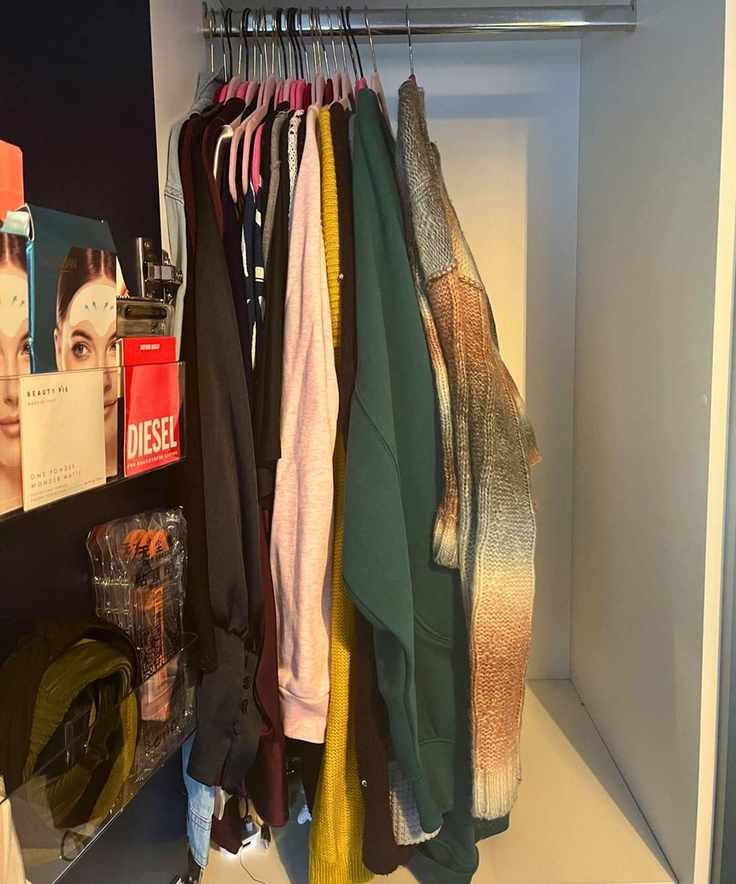
AFTER
My small closet is filled with sweaters, knits, hoodies, and bulky items I've gathered over the years. I take good care of my clothes, properly washing, drying, and storing them, so I rarely discard items due to wear.
Consequently, my winter collection has expanded significantly, particularly due to my fluctuating weight, turning it into an inertia-filled category.
Utilizing the Threshold Test on my winter garments allowed me to remove nine knitted sweaters and a bulky fleece I had recently purchased but didn't enjoy, all in under five minutes.
I also combined this test with the Great Over Good method after realizing I owned five white knitted sweaters. Yes, five! This made trimming down costly duplicates easier since one particular sweater is my favorite and receives the most wear.
Before implementing the Threshold Test, I had procrastinated on cleaning my closet. However, this method, with a clear rule and straightforward criteria for evaluating items, made it simple to decide what to keep or discard.
The items I removed were listed on Vinted in under 15 minutes. It's a quick way to sell unneeded items, especially clothing, and I appreciate that you can generate postage labels directly through the app, simplifying the process.
VERDICT: 10/10 for simplicity and effectiveness, plus it's incredibly fast.
Recommended Products
 Streamline visual clutter
Using matching velvet hangers gives a tidier appearance to closets, as their uniformity draws the eye upward. You can also mix colors of the same style to categorize clothing types and establish a simple organizing system.
 Space-saving
Maximize vertical space with stacked hangers that exploit your closet's height when rail space is scarce. These were a transformative solution for my compact closet. This twin pack offers space equivalent to 12 hangers.
 Multi-layered
These tiered trousers hangers save space while securely holding pants. Anti-slip ends make it easy to hang items, ensuring they stay in place.
 Two-pack
Need extra shelf space? This dual organizer attaches to your hanging rail, providing storage for accessories, shoes, or folded clothes above, with a rail below. I love its practical design.
 Renter-friendly
I have two of these metal hooks on every door upstairs, utilizing them for dressing gowns, towels, and outfits for the next day. Just clip on, and they're ready to use—no damage or drilling required.
If closet space is an issue, consider moving some clothes into long-term storage. Similarly, decluttering your kitchen cabinets and other busy areas can create a more calming environment.