
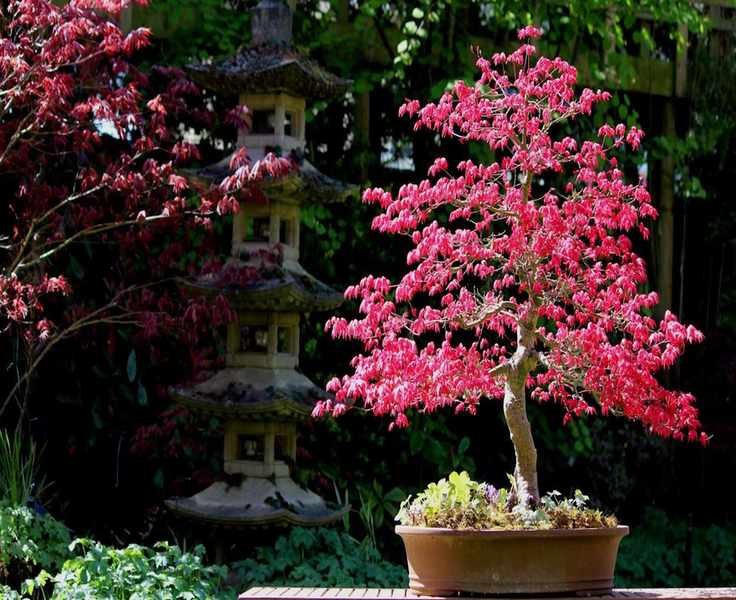
Known worldwide, Acer palmatum is celebrated for its stunning foliage in autumn. The 'Bloodgood' variety, for instance, transforms from deep purple to a bright pinkish-red in October and November, creating a breathtaking display.
Japanese maples are favored for bonsai cultivation, not just for their seasonal beauty but also because they are easy to maintain. They adapt well to small pots and respond positively to pruning, quickly forming attractive palm-shaped leaves.
Additionally, growing these trees in miniature allows for a more thoughtful and meditative gardening experience. If you're looking for a rewarding hobby, consider cultivating Japanese maple bonsai trees. Whether you have a compact balcony or a spacious garden, this endeavor can become a delightful passion.

Growing Japanese Maple Bonsai Trees
Caring for bonsai trees is more intricate than tending to regular shrubs or trees. Many may hesitate to try bonsai due to its perceived complexity, but by adhering to established practices from China and Japan, you can achieve impressive results. Among various types of bonsai trees, Japanese maples are excellent for beginners.
Starting with Japanese Maple Bonsai Trees

When growing Japanese maples in pots, these stunning trees thrive best in U.S. hardiness zones 5 to 8, withstanding winter temperatures as low as -20°F/-29°C.
According to plant expert and director of Living Collections at South Coast Botanic Garden, Terry Huang, "Japanese maples are woodland plants that favor dappled shade found at forest edges. They generally dislike direct exposure to sunlight, thriving better with morning sun and afternoon shade or dappled light throughout the day."
These guidelines apply to bonsai versions as well. Terry advises that full sun or hot, dry climates are unsuitable for these plants. Therefore, choose a sheltered, partially shaded spot for your bonsai to flourish.
Before planting, find a suitable, shallow bonsai pot with a drainage hole. Japanese maples dislike waterlogged soil. For beginner-friendly options, ceramic bonsai pots can be found on Amazon. Start with a pot that fits your Japanese maple's size, and replant into larger pots as it grows.
For soil, a bonsai mix is ideal, offering adequate drainage and nutrients through added horticultural grit.
This blue bonsai pot combines aesthetics and functionality, ensuring your bonsai remains healthy while looking attractive.
This soil blend is specially designed for bonsai trees, ensuring optimal drainage and nutrient supply for your miniature plants.
This durable two-tone ceramic bonsai planter not only looks great but is built to last, making it a wonderful addition to your patio.

Japanese Maple Varieties to Consider

There are numerous varieties of Japanese maples, but selecting a dwarf variety with small leaves yields the best results. For example, Acer palmatum 'Deshojo' offers striking orange-red foliage. You can order Acer palmatum 'Deshojo' live bonsai plants from Walmart.
Another attractive option is Acer palmatum 'Katsura', which features yellow leaves with a unique crimson edge. This variety thrives in U.S. hardiness zone 6 and beyond, making it a vibrant choice for colorful planters. Acer palmatum 'Katsura' starter plants are available on Amazon, easily pruned and shaped into bonsai.
If you appreciate the classic plum-purple coloring, consider Acer palmatum 'Crimson Queen'. This weeping variety boasts dark foliage that turns brilliant red in autumn. You can find Acer palmatum 'Crimson Queen' live bonsai plants at Walmart.
This bonsai starter kit includes all essentials for successful miniature gardening, from seeds and soil to pots and scissors.
Ongoing Care for Japanese Maple Bonsai Trees
If you haven't purchased a pre-trained bonsai, you'll need small canes and bonsai wire for shaping your tree as it matures. Bonsai wire is available from Walmart. Young stems can be easily bent and tied, allowing for a structured canopy.
Your goal is to create a miniature version of a full-sized Japanese maple. Over time, as the trunk thickens, it will support the canopy without additional support.
Pruning, shaping, and tying stems can occur throughout the growing season, so include these tasks in your spring and summer gardening checklists. Regular maintenance is crucial as neglected bonsai can quickly lose shape.
When it comes to watering, ensure you hydrate your Japanese maple bonsai during spring and summer, as pots dry out quickly in warmer months. A helpful technique is to submerge the planter in a bucket of water for at least 15 minutes weekly, ensuring proper drainage afterward.
Lastly, understanding how to fertilize your Japanese maples is crucial for bonsai in small pots. Bonsai fertilizer can be ordered from Walmart. Feed your Japanese maple weekly in spring and summer, then reduce to bi-weekly in fall. Winter months don't require feeding.
FAQs
Can I grow Japanese maple bonsai trees indoors?
No, it's not recommended to grow Japanese maple bonsai indoors. Acer palmatum needs cold weather in winter and fall to complete its dormant cycle. Indoor heating can disrupt this process, leading to pest and disease issues.
How do you winterize Japanese maple bonsai trees?
Generally, Japanese maples are hardy and don't need winterization. However, if you're in U.S. hardiness zone 5 or below, where temperatures can dip below -15°F, take precautions. Relocate your bonsai to a sheltered area near your home to shield it from harsh winds. Wrapping the pot's base in burlap from Walmart can protect the roots during frost and snow.
Younger Japanese maple bonsai benefit from annual repotting to encourage growth and refresh the soil. As they age, you can reduce repotting frequency. For trees over 10 years old, repotting every three to four years is sufficient. Bonsai repotting can be a bit tricky, so take your time to avoid damaging the roots.
For more inspiration, explore our guide on bougainvillea bonsai trees to enhance your miniature plant collection.



