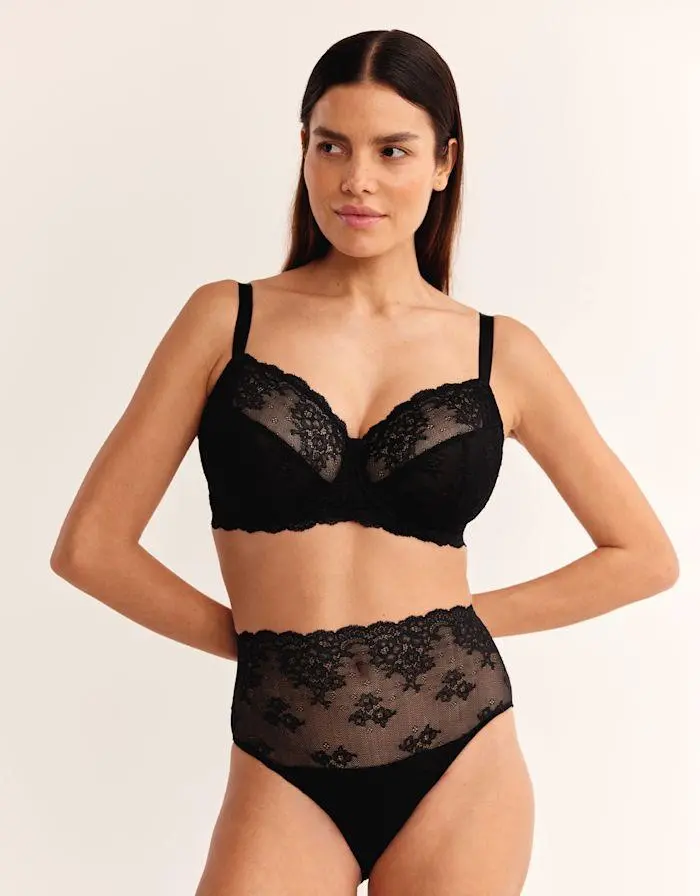
Bra cup sizes play a vital but often misunderstood role in finding the right fit. While many women focus on the letter (A, B, C, D, etc.), it's important to realize that cup sizes aren't universal; they work alongside band sizes to determine fit.
A proper bra fit is crucial for comfort and support, making it essential to understand how to achieve it.
Grasping cup sizes can transform how your bras feel and look. Studies indicate that nearly 80% of women wear poorly fitting bras.
Using a size calculator can assist in finding your ideal size and enhancing your overall fit, especially when you learn the intricacies of bra sizes and the importance of proper measurements.
What Are Bra Cup Sizes?
Cup size measures breast volume relative to band size, based on the difference between bust and band measurements taken with a measuring tape:
- Your bust measurement (around the fullest part of your breasts). This measurement should be taken while standing straight, arms at your sides.
- Your underbust measurement (around your ribcage). This measurement should be snug directly beneath the breasts.
If your band measurement results in an odd number, round it up to the nearest inch to establish your band size.
The difference in inches between your band size and bust measurement determines your cup size, with each inch equating to a cup size increment. Bra cup sizes denote the volume difference between underbust and bust measurements, with letters increasing by approximately one inch. Thus, understanding the practical implications of bra cup letters is beneficial.
Cup Size Chart (General Reference)
Though sizing may vary by brand, here's a standard guide:
- 1-inch difference = A cup
- 2-inch difference = B cup
- 3-inch difference = C cup
- 4-inch difference = D cup
- 5-inch difference = DD (or E)
- 6-inch difference = DDD (or F)
- 7-inch difference = G cup
In both the U.S. and U.K., the difference between bust and band size corresponds to one cup size. Conversely, in many European nations, cup sizes increase by one for every 2 centimeters of difference. Remember, cup size is a ratio and not fixed; the actual volume increases with band size, which is why it's helpful to explore the variations in cup sizes across systems and brands. Cup sizes originated in 1932, while band sizes gained popularity in the 1940s.
Consider this a preliminary guide, not a strict rule.
Decoding Band Size
Band size is crucial for professional bra fitting, providing essential support. To find your band size, wrap a flexible tape measure snugly around your rib cage, just beneath your bust, following an expert guide on measuring your band size. Maintain a level measurement, ensuring the tape is flat against your skin. If you measure an odd number, round it up to the next even number, as bra bands are typically sized in even numbers. For instance, a 31-inch measurement would round to a 32 band size. The band should feel snug but not overly tight, and it's normal for sizes to differ between brands. Always try on various bands and styles to find what offers the best support for your unique shape.
Why Cup Size Varies Across Bras
Many believe that a D cup is always large, but cup size is dependent on the band. Understanding whether a D cup is genuinely large relies heavily on band size and body frame.
For example:
- A 32D has less volume than a 38D
- A 34C and 36B can have similar volumes
Cup size is relative to band size; thus, a D-cup on a 32-inch band is smaller than a D-cup on a 36-inch band. These variations are termed sister sizes, which offer the same volume but different band measurements. However, a 34B from one brand may not fit the same as a 34B from another. The larger the cup size, the more significant the variation in fit across brands, making questions like whether a 36C is a large size context-dependent. Both band and cup size must be evaluated together for an accurate fit.
Types of Cup Sizes and Their Implications
Cup sizes influence bra design and support styles. Selecting the right cup size and bra style enhances comfort and appearance, particularly for those wanting to understand what a D cup signifies and how to find the right fit.
For instance, a demi bra is excellent for rounded or heart-shaped breasts, providing a flattering neckline and support.
Smaller Cups (A–B)
- Typically require lighter support
- Pair well with bralettes and soft cups
- Ideal for minimal or natural shaping
- Women with asymmetrical breasts may prefer bras with adjustable or dual-cup options available from select brands
Medium Cups (C–D)
- Offer balanced support and shaping
- Fit a wide array of bra styles
- Common in everyday bras
Full Bust (DD and Above)
- Require additional structure and support
- Benefit from underwire, wider straps, and full coverage
- Designed to distribute weight comfortably, especially crucial for larger sizes like E cups
Cup Size and Breast Shape
Understanding breast architecture is key to achieving the right fit. While cup size relies on the difference between bust and band measurements, how breast tissue fills the cup varies with individual shapes. Common breast profiles include round, bell-shaped, and teardrop. Each responds differently to various bra designs. For instance, round shapes work best with balconette styles, while bell shapes benefit from full-cup constructions. Recognizing both cup size and individual breast shape is essential for selecting bras that provide optimal support and comfort.
Signs of Incorrect Cup Size
Wearing the wrong cup size can lead to discomfort and unsatisfactory appearance. Look for these signs:
- Spillage over the cup's top or sides indicates the cup is too small
- Gaps or wrinkles in the fabric suggest the cup is too large
- Underwire resting on breast tissue can mean the cup size is inadequate
- Cups shifting or feeling unstable
If the band feels tight or leaves marks, or if the bra feels uncomfortable, it may indicate the band or cup is too small. The most common mistake is choosing a large band with a small cup. Many women suffer discomfort due to poorly fitted bras.
If any of these issues sound familiar, it's time to remeasure.
How to Determine Your Correct Bra Size
To achieve the best fit, it's crucial to measure accurately. Many women forget to recheck their sizes, yet it's advised to measure every six months as body size can fluctuate. Since sizing systems differ globally, they can only provide an approximate fit. Studies indicate that 70-85% of women wear ill-fitting bras.
- Measure your underbust snugly.
- Measure your bust at its fullest point, using a relaxed measurement.
- Calculate the difference.
- Refer to a size chart for guidance, keeping in mind that sizing is approximate.
- Experiment with different styles and adjust as necessary.
Remember, sizing can vary between brands, so don't hesitate to try various options.
Selecting the Right Bra for Your Lifestyle
Choosing the right bra goes beyond sizing; it requires understanding how specific designs meet your lifestyle and wardrobe needs. For active pursuits, a performance sports bra offers essential support and movement-friendly features. In professional settings, a seamless t-shirt bra provides smoothing benefits beneath clothing while offering gentle contouring. For leisure, soft cup bras are ideal for casual wear. Consider the fabric and neckline of your most frequently worn outfits, as certain bras are engineered to remain discreet beneath various fabrics. By evaluating your lifestyle and clothing choices, you can build a lingerie collection that ensures superior fit and comfort.
Importance of Correct Cup Size
The right cup size does more than enhance appearance; it impacts performance.
- Better support: Reduces pressure on shoulders and back.
- Improved comfort: Prevents digging and slipping.
- Enhanced shape: Creates a smooth silhouette.
Poorly fitting bras can lead to various discomforts, including shoulder, back, and breast pain. Ensuring an accurate fit is crucial for both comfort and health.
A well-fitting cup allows your bra to function effectively.
Care and Maintenance for Your Bras
Proper care of your bras is essential for maintaining their quality. Hand wash delicate undergarments in cold water using gentle detergents that protect the delicate fabric and underwire. During drying, lay your bra flat on a clean towel, reshaping the cups and straps. Avoid hanging by the straps, as this can stretch and damage the elastic. Store bras away from sunlight to prevent fading and fabric wear. Regularly check for signs of wear, such as frayed straps, to determine when replacements are needed. By following these care tips, your bras will continue to provide the support you need.
Final Insights
Understanding cup sizes is essential for ensuring your bra fits, supports, and feels right. Knowing how cup sizing works empowers you to shop confidently and choose styles that truly complement your shape.
Many women own multiple bras for various outfits, including specialty styles like strapless bras for off-shoulder looks. Remember, the average bra size varies by region; for example, the U.S. average is 40C, whereas in Norway, it's 38D.
Ultimately, the perfect fit isn't defined by the label, but by how you feel wearing it.