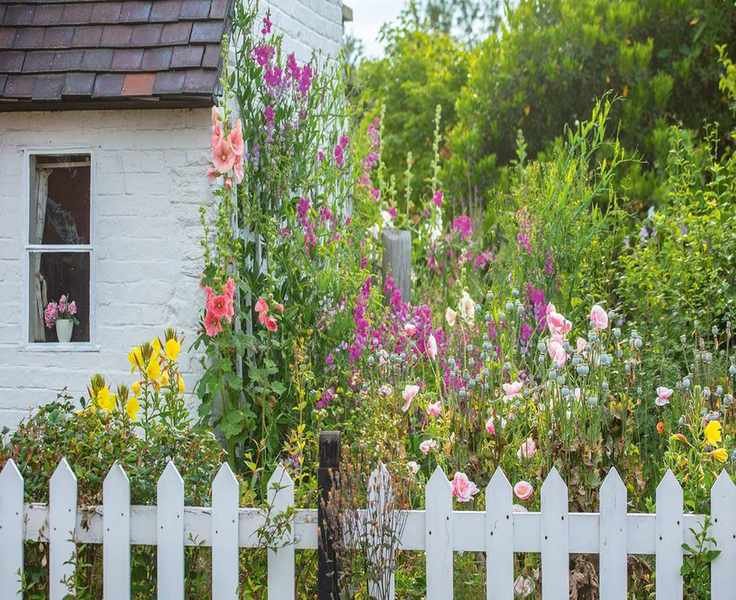
After months of stillness, nostalgia has washed over me like the tide. I’m grateful for all my adventures, the highs and the lows. Here, I’ll share some of my treasured travel photos from the past decade, along with their backstories and camera settings. One of the biggest challenges for a travel photographer is balancing the moment's quality with that of the image. The five selected images embody this duality—each tells a story, either captured in a fleeting moment or revisited multiple times. I’ll also offer photography tips and insights into my gear setup at the end.
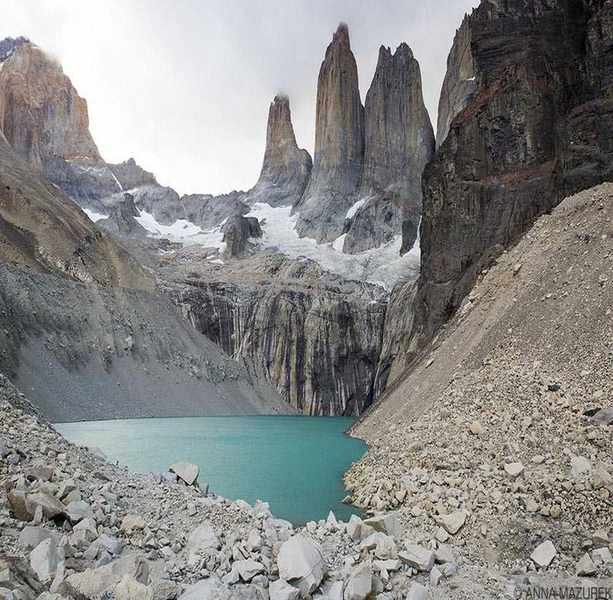
Torres del Paine, Chile
Exposure: f/9 at 1/160 second; ISO 800; 24-70mm lens (shot at 26mm)
Story: During my seven-month adventure in South America in 2015, I hiked the 40-mile W Trek at Torres del Paine National Park, which took five days. The highlight is this breathtaking view of three stone towers.
Let me recount the series of misadventures leading up to this shot. (Imagine Morgan Freeman narrating.)
This was my first multi-day hike, requiring me to carry all my supplies (food, tent, etc.). Thankfully, I could drink stream water, saving me from excess weight! Each day's elevation varied from 200 to 2,800 feet, which was manageable. The W Trek is moderately difficult, as it requires no technical climbing skills. The toughest part is enduring five days of hiking with all your gear through changing weather.
I had to rent all my gear, including my backpack, in Puerto Natales. Unfortunately, I couldn’t find hiking shoes in my size, so I wore my Nikes. (Cue Morgan Freeman: “This was a poor choice.”) Upon starting the trail, the strap on my rented backpack ripped, leaving me three hours from the rental shop.
Naturally, I overpacked. I wish I had weighed my pack, but it was likely around 30 pounds—heavy for someone weighing 115. (Morgan Freeman is shaking his head in disbelief.) Because of the broken strap and the weight, I needed help to put on my backpack. I struggled to stand up from a seated position and couldn’t lift it with one arm.
The rocky path lacked traction, and my Nikes weren’t helping. I frequently slipped, and falling was embarrassing. (Morgan Freeman: “This happened often.”)
After starting the trek, I spotted an Australian guy using a tree branch as a walking stick. I praised his idea, and he found one for me. I quickly gathered another, naming them Gertruda and Rodolfo—they truly saved my knees.
Two hours in, the weight of my pack and slippery shoes got to me, and I cried from the pain. (Morgan Freeman: “Lack of sleep from packing until 3 a.m. didn’t help.”) When I reached camp, I almost quit, even considering hiring a donkey to carry my pack.
After a good night’s sleep, I decided quitting was silly. I accepted the pain and focused on moving forward, limiting breaks to every two hours. Each step brought me closer to camp. I only stopped in strategic spots where I could easily put my pack back on.
The park is notorious for fierce winds that can rip off rain covers, so I wrapped my clothes in garbage bags based on rental shop advice. At one point, gusts were so strong that people fell to the ground. I felt the wind trying to lift my pack and push me toward a steep drop-off. I dug my walking sticks into the ground and leaned against a rock wall to stabilize myself. Gertruda and Rodolfo saved me!
On the fourth night, I camped at the base of the towers and hiked 45 minutes to the iconic viewpoint for sunset and sunrise—the best times for photos. The trail transitioned from forest to open rocks. At one point, I lost the trail and scrambled up a steep sandy cliff, mistakenly following footprints. (Cue Morgan Freeman: “That was not the trail.”) After backtracking, I eventually found my way, and upon rounding a curve, all exhaustion faded away at the stunning sight.
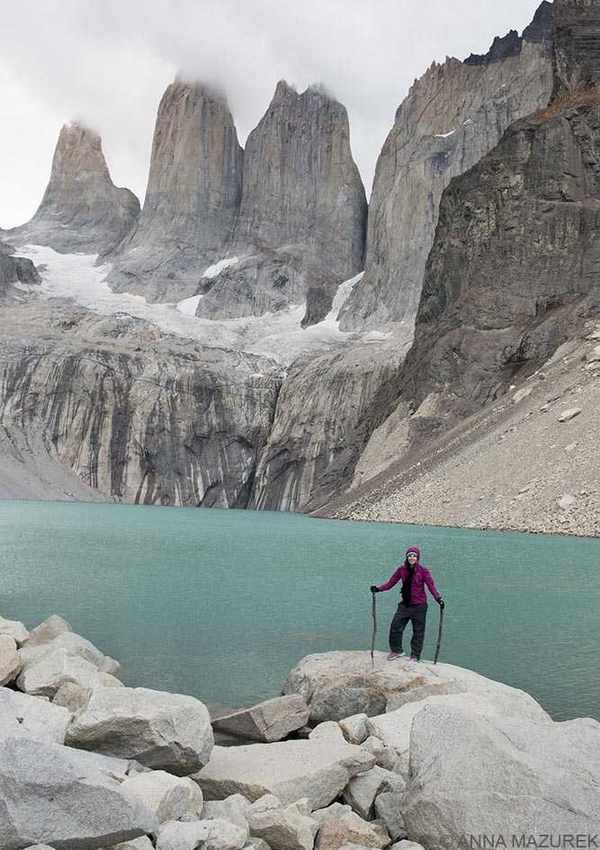
At sunset, the area was mostly deserted, offering perfect lighting—soft enough to eliminate glare yet bright enough to reveal the vibrant colors of the towers and foreground rocks. Many hope for a blue sky behind the towers, which is rare due to clouds and fog, as I discovered during my sunrise visit. It was freezing, and the clouds didn’t clear, resulting in snowfall. I was grateful for the Antarctica jacket gifted by a one-armed man at a hostel. (Morgan Freeman: “All she had besides that jacket was a $20 hoodie and a raincoat.”)
After capturing this image, I dashed to the water for more photos, and someone took one of me with my beloved walking sticks. All the struggles were worth it for this moment.
Naivety taught me a lot. This trek transformed me into a genuine hiker. (Morgan Freeman: “She invested in hiking boots, thermal layers, and learned to pack lightly.”) Two and a half years later, I tackled Kilimanjaro.
(Morgan Freeman: The W-shaped trail has this spot at the far right. She started on the other side to finish the hike here, which takes around nine hours of uphill hiking from the entrance by Refugio Las Torres.)
I left Gertruda and Rodolfo for someone else to use.
Photo Notes: Ideally, I’d have shot this at a smaller aperture like f/11 for more depth of field. I aimed to keep the ISO as low as possible.
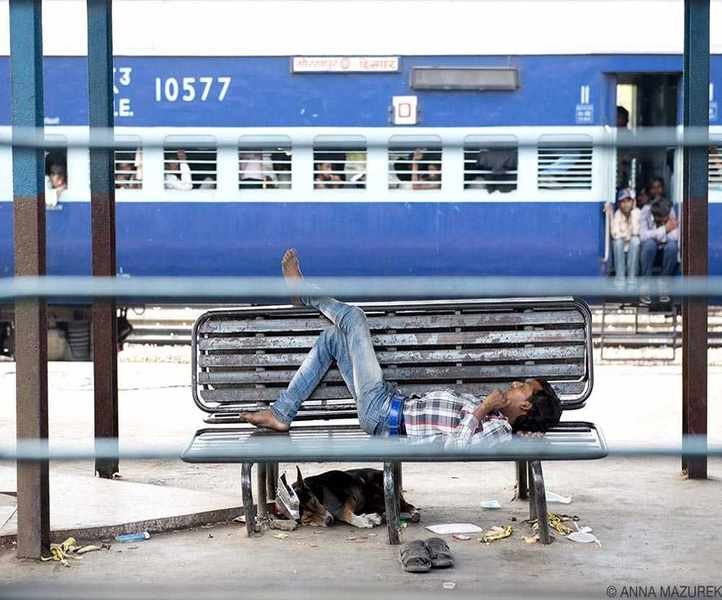
India Train Station
Exposure: f/4 at 1/250 at ISO 640; 24-70 mm lens (shot at 70mm)
Story: I spent five summers in India managing photo trips for high school students. Staff would arrive early for training meetings before the students. We’d meet in hot Delhi and then head north to McLeod Ganj, near the Himalayas and home to the Dalai Lama. Typically, we rented jeeps for a 10-12 hour drive. However, our new director decided we should take an overnight train instead. Due to limited air-conditioned sleeper beds, we ended up in open-air sleeper cars, three beds on each wall. (Cue Morgan Freeman: “It’s 100 degrees at midnight in Delhi in June. She was thrilled.”)
Jet-lagged and headachy, I curled up on the slightly padded canvas slab with my silk sleeping bag liner and inflatable neck pillow, clutching my camera bag. Upon waking at our destination, I was coated in dust from the open window, which settled on our sweaty bodies.
As I gathered my belongings, I glanced out the window and spotted a quintessential India scene—a man sleeping on a bench with a dog beneath him, surrounded by trash and banana peels. His shoes were neatly placed beside him, and neither seemed bothered by the trains passing nearby.
I quickly grabbed my camera and adjusted the exposure, capturing five frames before the train continued on.
This photo reflects the charm and chaos of India. I’m always in awe of how locals can sleep soundly anywhere—on cars, concrete doorways, or even in the scorching heat of busy highways.
Photo Notes: I wish I’d shot this at a smaller aperture like f/7.1 or 8, but I only had a few moments to capture it. Hindsight is 20/20.
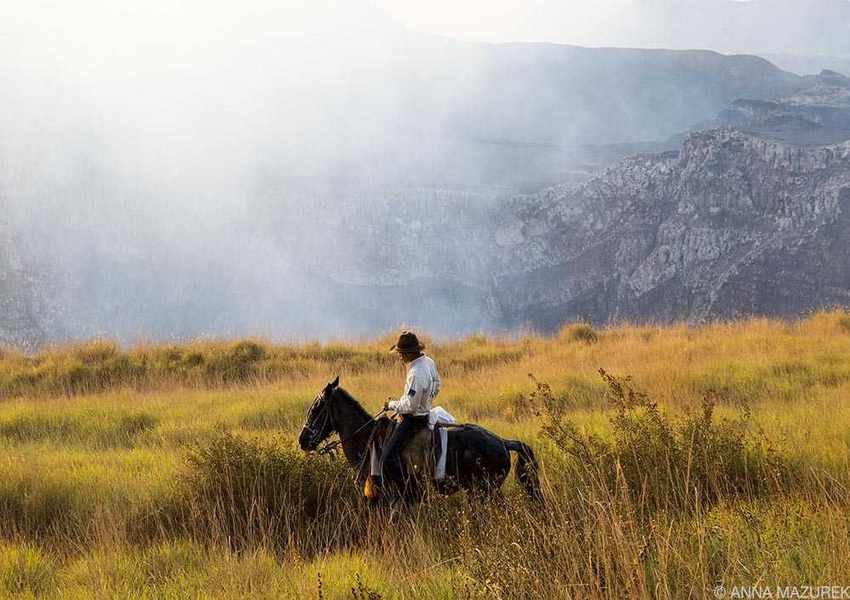
Exposure: f/6.3 at 1/400 at ISO 800; 24-70 mm lens (shot at 48mm)
Story: I had a day to spare in Granada, Nicaragua, and opted for a tour to the Masaya Volcano crater. I had spent too long in Granada for various friend meet-ups and wanted to maximize my time.
Though I dislike day tours, I had little choice due to the distance. The crater was massive, and you could walk right to its edge. (In the U.S., they’d make you sign a waiver!) It was challenging to photograph, as the smoke resembled clouds or fog without any captivating foreground.
On the way back, I spotted three men on horseback along the crater’s edge. I dashed down the stairs and across the road, capturing 12 frames—four of each rider. This shot features the second rider, and I consider it unscripted perfection, with the sun illuminating his face, grass framing his hat, and rocks peeking through the smoke. It's my favorite from Nicaragua.
Photo Notes: Ideally, I would have preferred a slightly smaller aperture, but I had limited time to adjust settings as the horses approached.
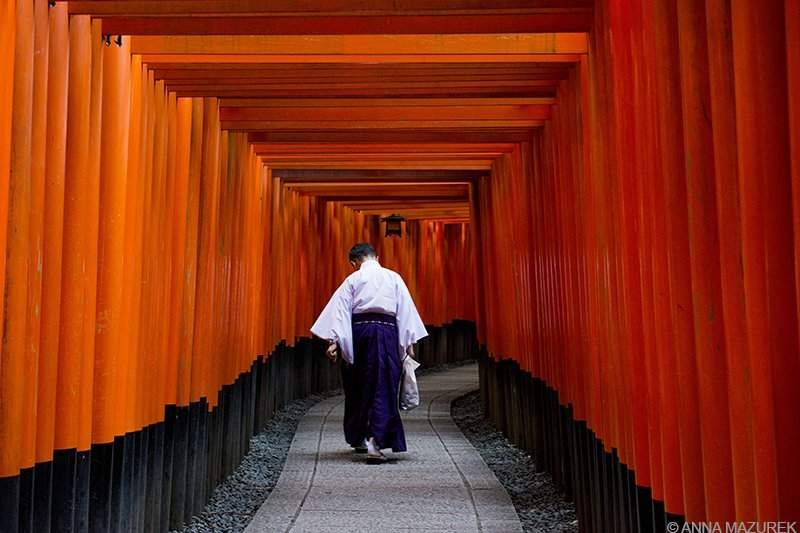
Fushimi Inari, Kyoto (September 2013)
Exposure: f/6.3 at 1/60 at ISO 2500; 24-70mm lens (shot at 70mm)
Story: One of my most cherished days in Japan was my sunrise visit to the Fushimi Inari Shrine. To avoid crowds, I took the first train and enjoyed two and a half glorious hours alone, aside from a few locals. I was photographing my gnome when a man in traditional attire rushed by. I quickly set aside my gnome and captured several frames before he disappeared.
(For a detailed account of this trip and my 300 mosquito bites, check out this post!)
Photo Notes: Given the low light and shaded scene, I aimed for a low ISO while using my old D300, which isn’t great with noise. I try to keep the shutter speed above 1/30 or 1/60 to prevent shake.
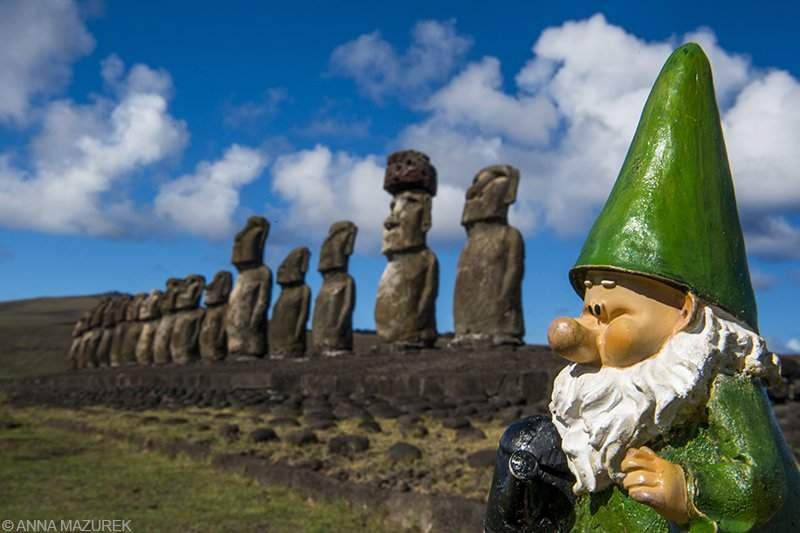
Easter Island, Chile (March 2018)
Exposure: f/22 at 1/125; ISO 400; 24-70 mm lens (shot at 36mm)
Photographing gnome photos can be tricky. I’ve been shooting Alfred for over ten years, and even lighting is essential for both him and the background. Bright light can make him shiny—something he despises. Typically, sunrise, sunset, or overcast days work best.
To ensure both Alfred and the background are in focus, I need a small aperture (f/16-22) for greater depth of field. This, combined with softer light, sometimes requires a higher ISO. But I can’t go too high, or Alfred will look grainy.
Timing and composition are key to avoiding distractions (like people in bright colors or those taking endless selfies). The sun illuminates the statues' faces at Ahu Tongaraki on Easter Island only in the afternoon, and the site closes before sunset, so I had to shoot in bright light. I returned three times, waiting until the crowds dispersed. I took test shots with Alfred to get the background right, then waited for distractions to clear. It took some effort to align Alfred with the statues, and I was among the last to leave that day. This is one of my favorite gnome photos ever. For more of Alfred’s travels, check out this gallery or read his biography here.
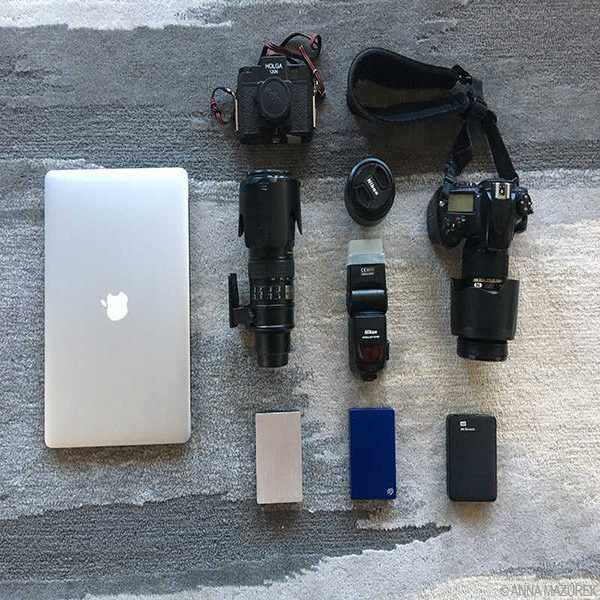
Camera Gear Insights
I want to outline my travel camera gear and share my thoughts on upgrading, something I planned before the pandemic. I’ve always used Nikon for digital photography (previously shot film on a Minolta). These images were captured with either my Nikon D300 or the current D800, a full-frame DSLR (36.3 megapixels). My lenses are all Nikon f/2.8 models, including 24-70mm, 70-200mm VR, and a 50mm f/1.8. I also acquired a 24-105mm f/4 after the zoom on my 24-70mm jammed in Thailand. A friend brought me a used Nikon 24-105mm for $600 while I sent my 24-70mm ($1,500 lens) for repair.
I planned to sell the 24-105mm when I returned in February, but I’ve held off due to the economy. I like the zoom range, which reduces lens changes, although it has a longer minimum focusing distance than my 24-70mm, which is frustrating.
My D800 is aging, and I’ve postponed buying a new body due to indecision. Plus, it still functions well. I want a lighter camera and considered mirrorless (Sony), but a full-frame body is only half a pound lighter, and the lenses remain the same weight. I’m not a fan of digital viewfinders on mirrorless cameras, as their focus can lag, causing missed shots. The short battery life is another drawback, along with the hassle of carrying multiple batteries. My Nikon only required one battery on my seven-day Kilimanjaro trek, and charging multiple batteries daily would be a challenge on rural trips with limited electricity. Switching to Sony means investing $8K for an equivalent kit after selling my Nikon gear, which I’m not keen on doing.
I also seek a camera with better ISO performance for low-light situations. In February, I considered the Nikon D850, which offers improved low-light capabilities and is compatible with my current lenses. I rented a D850 last year and liked it. I made this decision based on my upcoming photo contracts. Then, the pandemic hit, and I lost 80% of my work, so I’ve held off on purchasing a new camera until I better understand my future work. I plan to rent a Sony kit for a week this fall or winter to aid my decision-making process. (I usually rent gear locally in Austin at Precision Camera or through LensRentals.com for significant shoots like SXSW.)
For more photography tips, check this post out.
Photography Questions?
If you have any photography questions or topics you’d like me to cover in a future blog post, feel free to drop me an email here!